Top Story
Shaftesbury Capital’s Ian Hawksworth appointed as ULI UK Chair
The Urban Land Institute has appointed Ian Hawksworth, CEO of Shaftesbury Capital PLC, as ULI UK Chair

March 10, 2026
Improving fundamentals and an increase in the availability of capital have buoyed the real estate industry globally as a new cycle gathers pace, with greater stability around inflation and interest rates, and a sense that asset class valuations are rebounding from recent lows with liquidity returning to the United States, Europe and Asia Pacific. However, the prevailing uncertainty arising from deglobalisation, including volatile geopolitics and challenging economic conditions, still presents investors with a “major test of nerve”.
This is according to the Emerging Trends in Real Estate® Global Outlook 2026 from PwC and the Urban Land Institute (ULI), which captures the views of thousands of senior property professionals from across Europe, the United States and Asia Pacific to gauge global sentiment on real estate investment and development prospects.
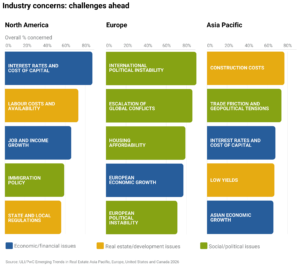
This year’s report illustrates a broadening in industry concerns across the globe arising of a number of geopolitical events in the last year. The international backdrop continues to shift at pace, requiring the industry to constantly pivot and adapt. The net result is that one year on, the industry believes there is a “real risk” that the effect on investment could be much the same in 2026
Diversification in investment
A consequence of the unavoidable risks from global volatility has seen a shift to diversification across both sectors and countries which is now regarded by leaders as essential to investment approaches. Pricing has also fallen enough in Europe and Asia Pacific to present an attractive trade-off with risk, while occupier markets have remained relatively healthy despite the economic conditions. The report also reflects a strong belief among leaders that real estate’s resilience should continue to shine through, despite the volatility.
Thomas Veith, Global Real Estate Leader, PwC comments: “The sustainable transformation of the industry continues to be in full swing. Real assets are shaping the landscape with a stronger focus on data centres and living. Tokenization is increasingly being used in fundraising.”
Simon Chinn, Vice President, Research & Advisory Services, ULI Europe, comments, “This year’s global outlook portrays an industry that is coming to terms with a changing investment landscape dramatically shaped by geopolitics, where the composition of available capital is shifting from institutional sources to new ones, and where strategic thinking and the flexibility to pivot can mean success. In an era where volatility might be our new normal, it’s clear that our industry’s leaders strongly believe in the resilience of real estate despite the current turbulence.”
The report also highlights a resurgence in retail and offices in selected markets, and how various retail subsectors and offices are now considered to be highly investable once again, particularly grocery based retail and local shopping centres attracting investors across all three regions, and office deals increasing by 18 percent year-on-year to $195.80 billion (MSCI data).
Data Centres moving from niche to mainstream investment in some markets
Once again, data centres have continued to lead the ‘sectors to watch’ rankings as one of the biggest opportunities for investment and development prospects across Europe and North America respondents, while Asia Pacific respondents regard them as the most attractive niche property type for the coming year.
Artificial Intelligence (AI) has seen an extraordinary global growth in data centres, and this year’s report indicates that the sector is moving from niche into mainstream investment in western markets, despite concerns about an “AI bubble” arising primarily from the vast capital expenditure on data centre mega campuses in the US. However, the report also notes the challenges, from water and energy consumption to the risk of obsolescence from technology advances.
Other high-ranking sectors to watch include senior housing and assisted living, industrial and logistics, private rented residential, student housing, healthcare, storage facilities, hotels, and affordable housing.
Evolving approaches to ESG
This year’s report also highlights an evolving approach to ESG (environmental, social and governance) strategies in real estate across the three regions. Views vary, with growing consensus in Asia that asset owners need to shift focus to deliverable and measurable initiatives, while European leaders see ESG increasingly as a pragmatic, not philosophical, endeavour, and leaders in the US focusing on ideas such as asset resilience in response to climate change rather than ESG itself.
Changing capital composition
Finally, this year’s report includes a dedicated focus on how the composition of capital is changing, and particularly the lasting influence that private wealth is expected to have on the global real estate investment landscape as target allocations from traditional institutional investment decline and competition for capital from infrastructure and private credit increases.
The increase in private wealth is expected to make up some of the short fall from traditional investment routes across the three regions, with high-net-worth individuals, private local investors, private equity and family offices all becoming more prominent funding sources in Europe and the US, while in Asia the trend is further pronounced with flows driven by expanding family offices, private banks, insurers and newer sovereign wealth funds.
Retail investors especially are already adapting to the evolving global market which in turn requires asset managers to adapt with evolving deal structures, liquidity planning and investor communications. The Emerging Trends in Real Estate® Global Outlook 2026 highlights the significance of aggregated retail flows into real estate, which could represent hundreds of billions to trillions in potential capital globally.
Gareth Lewis, PwC Director and PwC Emerging Trends in Real Estate leader, adds, “The real estate industry has been encouraged by improving fundamentals and the increasing availability of capital as a new cycle gathers momentum. Stepping back from the prevailing geopolitical uncertainties, our report identifies that it’s the changing nature – as much as the volume – of capital flowing into real estate that will be important to how the sector evolves in the coming years – alongside the shift towards operational assets, the increasing overlap with infrastructure, and the impact of technology and decarbonisation challenges.”
Simon Durkin, incoming CEO, ULI Europe, concludes, “While ULI and PwC’s annual barometer of global investment and development sentiment reflects understandable caution, particularly amid heightened geopolitical risk and ongoing macroeconomic uncertainty, it also points to a clear improvement in sentiment versus last year. Importantly, with much of the repricing across real estate now largely behind us, private markets are operating on a different cycle to public markets, creating a distinct set of conditions and entry points. Encouragingly, optimism remains widespread. The industry continues to prove durable and adaptable, and as the asset class evolves, debt markets remain supportive and compelling opportunities are emerging.”
-Ends-
Emerging Trends in Real Estate® Global Outlook 2026 is available from 10 March 2026 on ULI Knowledge Finder via knowledge.uli.org/reports/emerging-trends/2026/emerging-trends-in-real-estate-global-2026
For further information please contact:
Tony Nokling, Director, Communications, ULI Europe: [email protected]
Vanessa Okonji, Senior Associate, Corporate Affairs, PwC UK: [email protected]
Notes to Editors
About the Urban Land Institute
The Urban Land Institute is a non-profit education and research institute supported by its members. Its mission is to shape the future of the built environment for transformative impact in communities worldwide.
Established in 1936, the institute has over 48,000 members worldwide representing all aspects of land use and development disciplines. In Europe ULI has more than 5,500 members across 15 National Council country networks.
For more information on ULI, please visit https://europe.uli.org
About PwC
At PwC, our purpose is to build trust in society and solve important problems. We’re a network of firms in 151 countries with over 360,000 people who are committed to delivering quality in assurance, advisory and tax services. Find out more and tell us what matters to you by visiting us at www.pwc.com.
PwC’s real estate practice assists real estate investment advisers, real estate investment trusts, public and private real estate investors, corporations, and real estate management funds in developing real estate strategies; evaluating acquisitions and dispositions; and appraising and valuing real estate. Its global network of dedicated real estate professionals enables it to assemble for its clients the most qualified and appropriate team of specialists in the areas of capital markets, systems analysis and implementation, research, accounting, and tax.