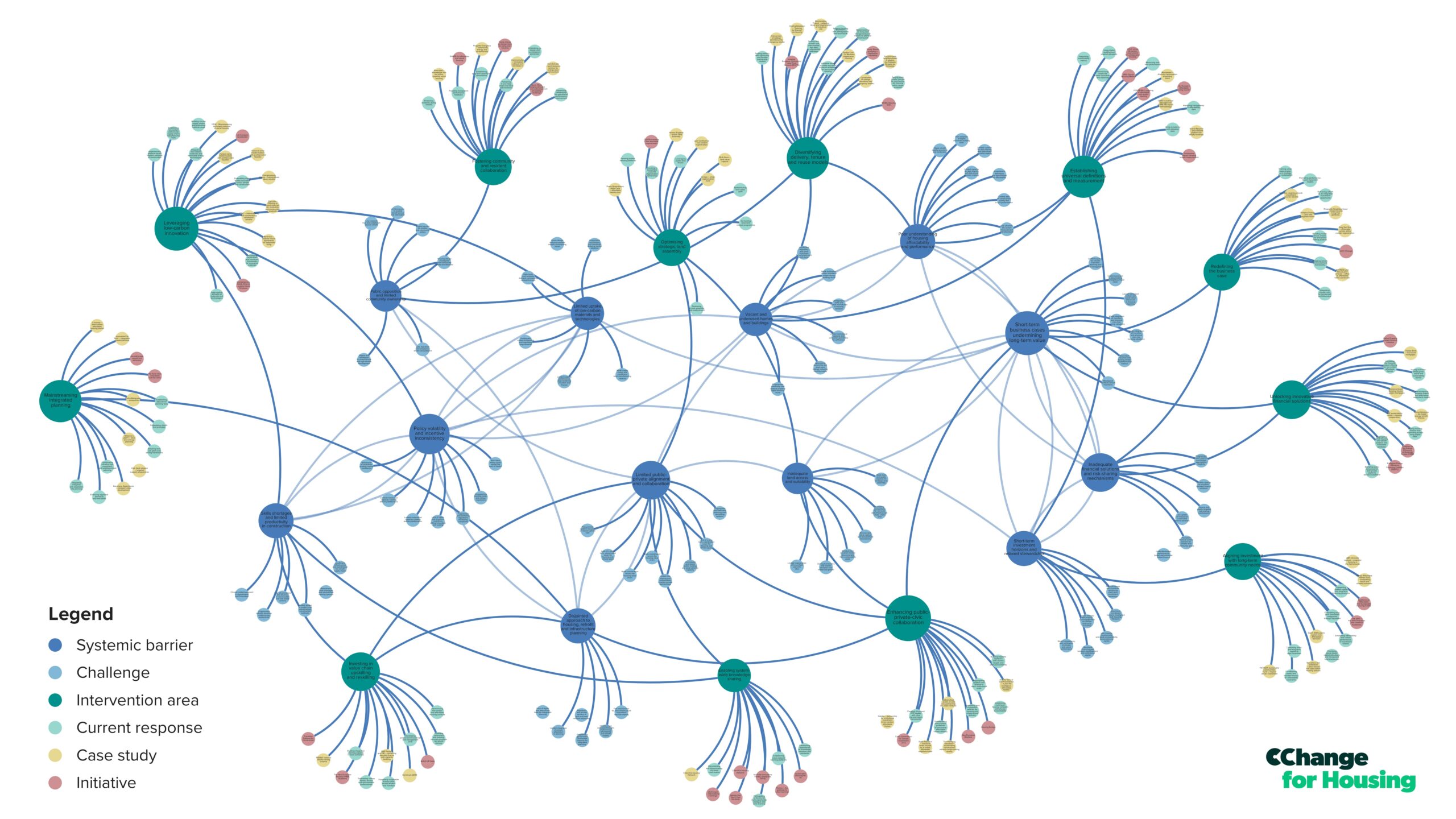
These twelve intervention areas represent a practical blueprint for where the industry can work together to unlock system-wide progress. C Change for Housing will initially focus on further exploring and scoping out three intervention areas selected by the steering committee where ULI is best positioned to convene stakeholders and accelerate change. They include:
• Redefining the business case
• Establishing universal definitions and measurement
• Leveraging low-carbon innovation
These priorities may evolve as the programme advances and new opportunities emerge.
The new interactive systems map and report also showcases dozens of case studies and initiatives from across Europe that are already providing real solutions to many of these issues, though often at a local level, ranging from innovative public finance models linking affordability and carbon performance, and digital platforms that track building reuse and circular construction, to low carbon modular micro apartments and serial retrofit projects with prefabricated facades that cut disruption and emissions. C Change for Housing will explore opportunities addressing how to deploy the principles of these exemplar projects at scale.
This mapping exercise marks the first phase of the programme, which will now shift from insight to mobilising the real estate industry to co-develop, test and scale solutions. This will include a series of planned workshops in the coming twelve months.
Sophie Chick, Vice President, ESG Programmes, ULI Europe, comments, “As millions across Europe face high rents and energy costs, and with ageing, inefficient homes driving a significant share of emissions, it’s encouraging to see many examples that are already making progress towards decarbonised affordable housing, though most remain small scale. Systemic change, will only be possible through genuine collaboration to scale what already works, align efforts to avoid duplication, and create a new ‘business as usual’ that delivers affordable, low-carbon homes at scale.”
Emily Hallworth, Manager, ESG Programmes, ULI Europe, adds, “C Change for Housing’s first outputs give the industry a shared evidence base and a clear set of intervention points where collective action can have real impact. This launch marks the beginning of a new phase focused on solutions, working with partners to make affordable, low-carbon housing the norm across Europe. Progress on this is essential not only for meeting climate goals, but for creating more resilient, equitable and thriving communities.”
The development of these resources was supported by global built environment consultancy Arup, consultants Dark Matter Labs, the C Change for Housing steering committee, and the ULI project team. The C Change for Housing programme is supported by funding from Laudes Foundation.
Access the C Change for Housing interactive systems map here and download the full companion report from ULI Knowledge Finder. To get involved in C Change for Housing and receive information about the programme as it evolves, register your interest or contact [email protected].
A dedicated, solutions focused C Change for Housing workshop will take place during the forthcoming C Change Summit in Paris (27 November) to help shape the next phase of action.
Press contact: Tony Nokling: [email protected]
Notes to editors
C Change for Housing is a ULI-led programme focused on mobilising the real estate industry to overcome barriers preventing decarbonisation of existing and future affordable housing in Europe. Launched in 2025 with support from the Laudes Foundation, the initiative builds on the success of ULI’s flagship C Change programme, applying its systems-change approach to identify where the housing system is stuck and where targeted interventions can have the greatest impact. By convening stakeholders across the private, public, and third sectors, C Change for Housing aims to co-create practical, scalable solutions that enable the transition to a low-carbon, affordable housing system across Europe.
More information is available at https://europe.uli.org/programmes/c-change-for-housing/
The Urban Land Institute is a non-profit education and research institute supported by its members. Its mission is to shape the future of the built environment for transformative impact in communities worldwide. Established in 1936, the institute has over 48,000 members worldwide representing all aspects of land use and development disciplines. ULI Europe has over 5,500 members across 15 National Council country networks and 13 Product Councils visit https://europe.uli.org